Putting down roots
The Vuarambon family acquires Estancia Santa Teresa. Sudestancia’s story begins with Merino sheep farming for fine wool.
 ESTANCIA
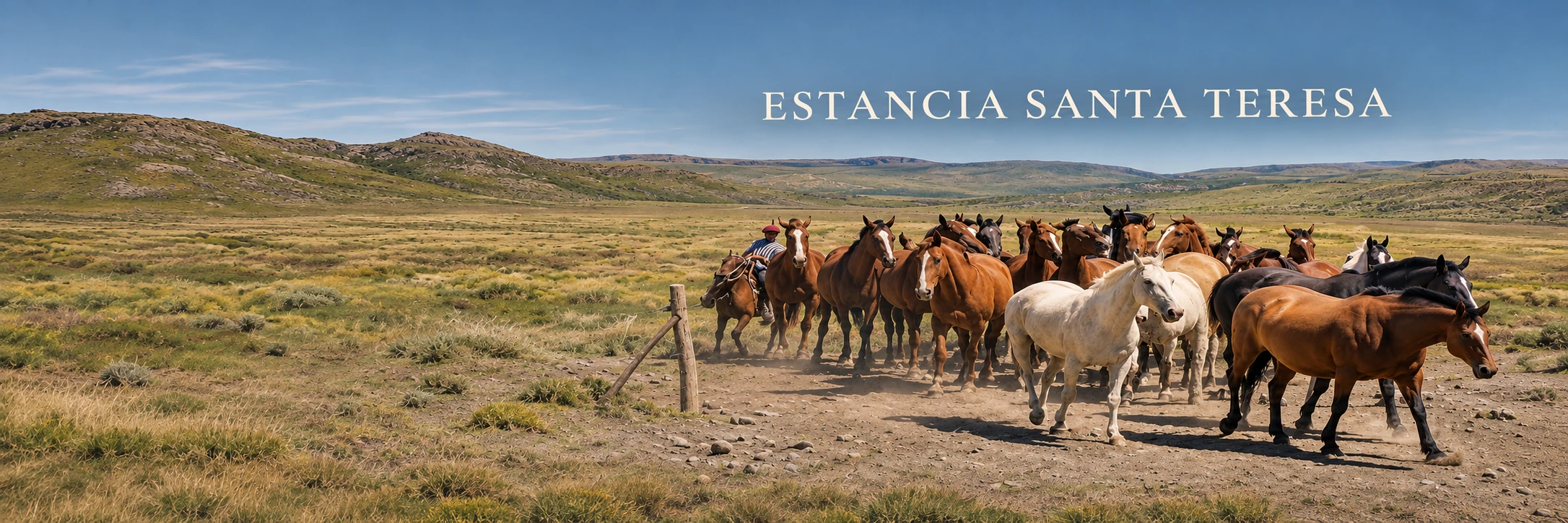
PIEDRA DEL ÁGUILA · NEUQUÉN · ARGENTINA
Family, farming and conservation in Argentine Patagonia.
OUR ROOTS
Sudestancia’s story began in 1968, when the Vuarambon family, who emigrated from Switzerland to Argentina, acquired Estancia Santa Teresa, near Piedra del Águila in the province of Neuquén.
Estancia Santa Teresa is owned by Sudestancia S.A., the Vuarambon family company.
Since then, family life and livestock farming have shaped this corner of Patagonia. Rides across the land, seasonal shearing and family gatherings are part of a story passed from one generation to the next.
THROUGH THE YEARS
The Vuarambon family acquires Estancia Santa Teresa. Sudestancia’s story begins with Merino sheep farming for fine wool.
The hotel adds tourism to farm life. Almost three decades of hospitality and encounters with visitors.
A gradual transition to Braford cattle opens a new chapter. The final sheep shearing takes place in 2003.
An agreement with Fundación Vida Silvestre Argentina establishes the Estancia Santa Teresa Private Reserve.
THE FARM TODAY
The wool crisis, rising relative costs and growing losses to predators led the family to explore alternatives. Developing a Braford herd suited to the demanding conditions of the land required years of work, observation and learning.
This experience was later examined in an agricultural engineering thesis by a member of the third generation: De Ovinos y Bovinos, exploring livestock farming alternatives in northern Patagonia.
The monte shrublands and Patagonian steppe are part of Estancia Santa Teresa’s identity. Their conservation goes hand in hand with livestock farming and the family’s long-term outlook.
The private reserve was established to protect these natural habitats while maintaining farming practices compatible with their preservation.
OUR PRODUCTION
Our main commercial activity is selling Braford calves for further rearing, raised on the estancia.
OUR MAIN SALE
We sell calves that will continue growing on other farms. Depending on the management of each group, they come from early or conventional weaning.
We sell cows and bulls retired from the breeding herd.
The estancia also sells cull horses.
Email us for details of available groups, their characteristics and terms of sale.
VIEWS FROM THE FARM
A journey through the landscape and life on the farm, from its sheep-farming days to cattle farming.
The Vuarambon family’s photographic archive: Estancia Santa Teresa and its surroundings.
Photographs featured in De Ovinos y Bovinos (2012). Archive images may not reflect the farm’s current appearance.
A SHARED HERITAGE
Today, the third generation participates in managing Sudestancia. The fourth, although not yet involved in running the business, already shares in family life at the estancia.
Estancia Santa Teresa remains a gathering place where generations come together, pass on memories, share traditions and create new experiences.
“We do not inherit the earth from our ancestors; we borrow it from our children.”
IN ARGENTINE PATAGONIA
Piedra del Águila · Neuquén
Patagonia Argentina